The iPhone 17 Pro has received a major telephoto upgrade compared to the iPhone 16 Pro: it now offers a significantly higher resolution and larger sensor size. And even though it provides only a 4× zoom instead of a 5×, that’s paradoxically an improvement. But how does it affect real photos? Let’s find out.
Telephoto test: iPhone 17 Pro vs. 16 Pro and 15 Pro
I admit this article and especially the video mirror exactly the questions that came to my mind when Apple published the specs of the iPhone 17 Pro. As soon as it arrived, I went to the center of Prague, bringing along my own iPhones 16 Pro and 15 Pro.
The key question is obvious: how much will this (fairly) dramatic change show in real life — in photos? How significant will the difference be compared to previous generations? And how will the 8× zoom perform, which Apple for the first time officially calls “optical quality”?
The easiest way to find the key answers is in the video I made after testing — it’s where you can clearly see the subtle nuances. Plus, it’s edited in HDR, so if you watch it on a quality display, the image quality will be very close to what I see on my own iPhone.
Video: Telephoto test of iPhone 17 Pro vs. its predecessors – 8 min in 4K HDR
How the telephoto lens differs from its predecessors
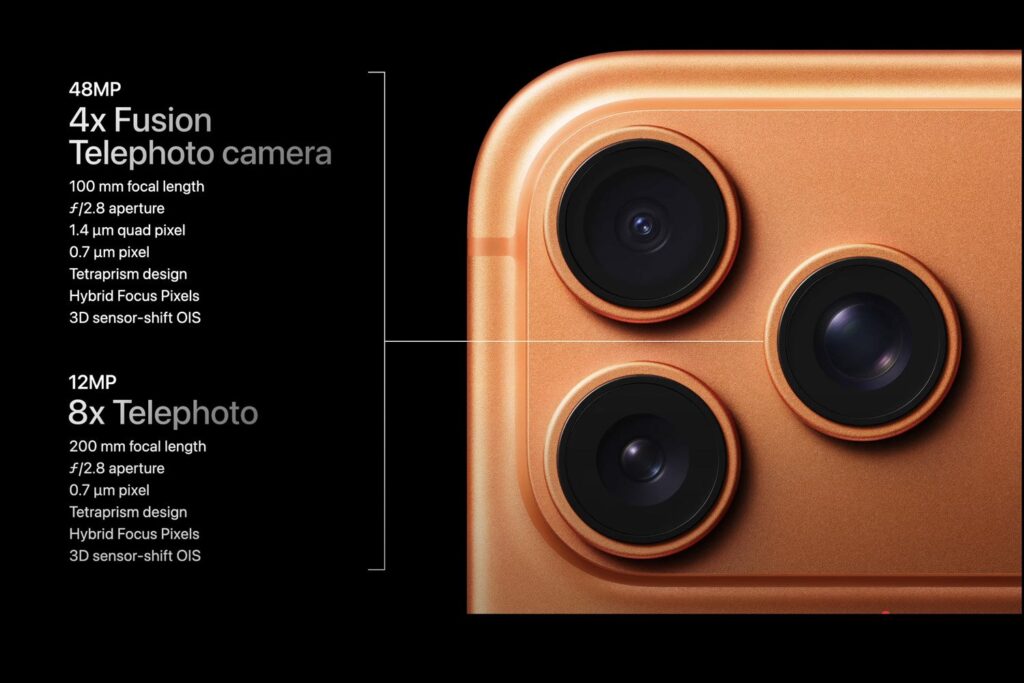
The essential changes are easiest to see in this comparison table showing the key parameters of the last three iPhone Pro telephoto lenses.
Telephoto lenses in the last three iPhone Pro models
| Telephoto lens | iPhone 15 Pro | iPhone 16 Pro | iPhone 17 Pro |
|---|---|---|---|
| Resolution (MP) | 12 MP | 12 MP | 48 MP |
| Sensor size | 12.0 mm² | 15.3 mm² | 23.5 mm² (+56%) |
| Optical zoom | 3× (77 mm eq.) | 5× (120 mm eq.) | 4× (100 mm) |
| “Optical-quality” zoom | 8× (200 mm) at 12 MP |
In summary:
– The iPhone 17 Pro has far more pixels on its telephoto sensor: 48 MP compared to 12 MP in previous models. More pixels generally mean more detail and better definition — and indeed, with the 15 Pro, I often hit the limit of how much detail zooming could retain.
– More pixels can theoretically bring more noise, but that’s offset by another key change: the sensor is 56% larger than in the iPhone 16 Pro (and much larger than in the 15 Pro). A larger chip always means better quality output — and since this is an official Apple spec, we can take it seriously.
– Another significant change is how far the telephoto “sees”: from 3× in the 15 Pro through 5× in the 16 Pro to 4× in the 17 Pro — which, as we’ll see, is actually a positive change for photographers.
– For the first time Apple uses the phrase “optical-quality zoom” — for the 8× zoom — indicating confidence in its image quality (digital zoom was possible before, but Apple rarely promoted it, as quality dropped quickly).
1. How much is the camera upgrade reflected in photo quality?
As mentioned, you can best see everything in the video — it’s the easiest way to compare, and thanks to HDR, it preserves the real photo quality much better than the web.
I tested exactly what I was curious about: taking the same shots with all three iPhones and comparing how much detail each can “pull out.” I photographed several test scenes and then compared how much detail and quality each could deliver.
No surprise: the iPhone 17 Pro offers the cleanest, most detailed results at extreme zoom — clearly thanks to its higher pixel count and larger sensor.
Looking from the other side: the iPhone 16 Pro performs very decently — yes, it shows fewer details and slightly softer definition, with some oversharpening and computational fill-in at maximum zoom, but it’s far from bad.
Compared to the 15 Pro, the difference is even more straightforward — the smaller 3× zoom and sensor mean it can’t quite catch up with the 17 Pro. But again, it’s no disaster.



2. How does the 8× “optical-quality” zoom work?
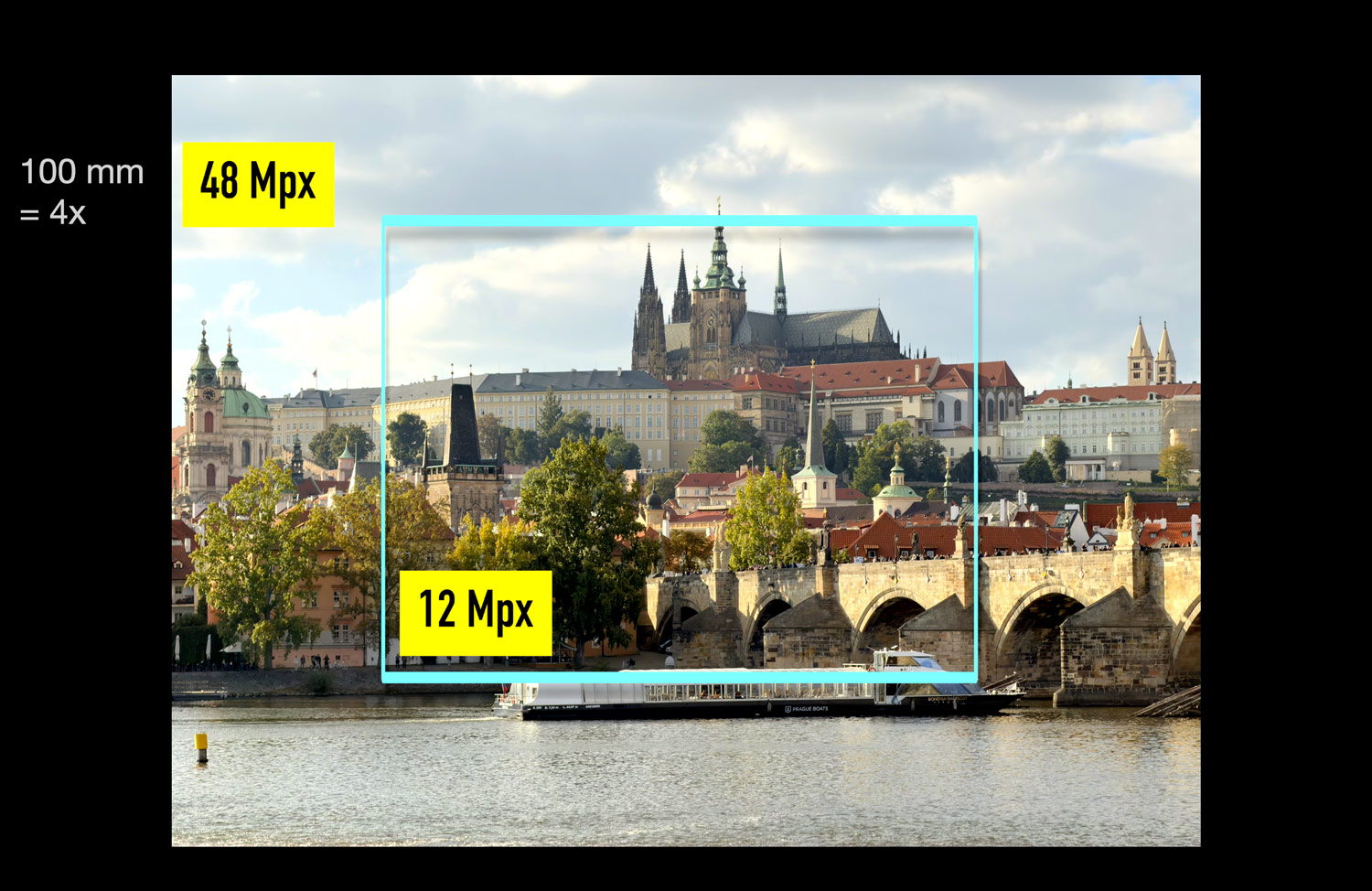
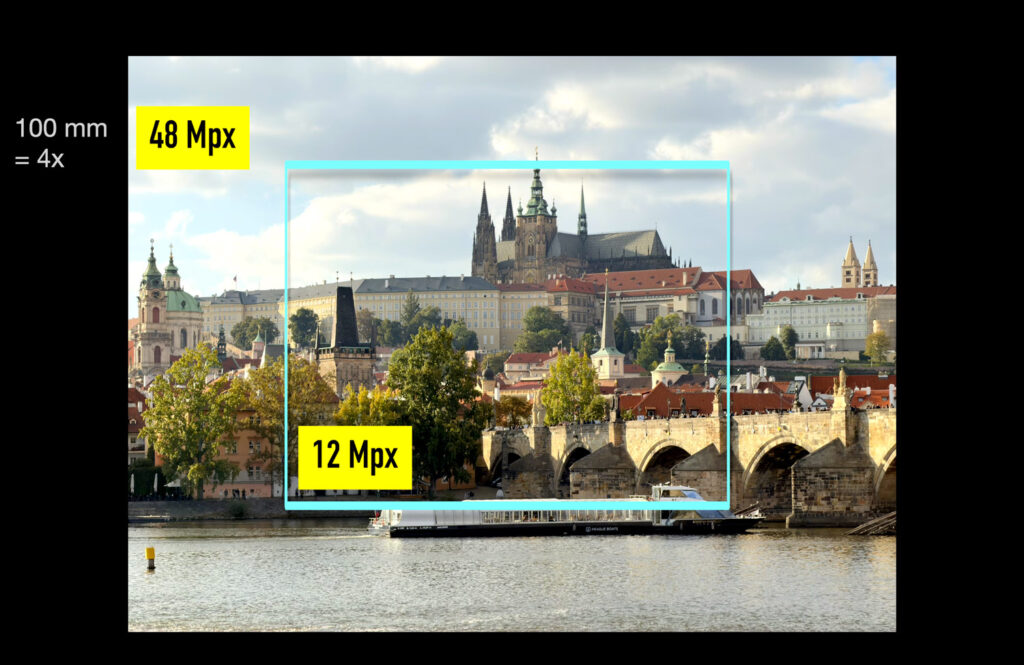
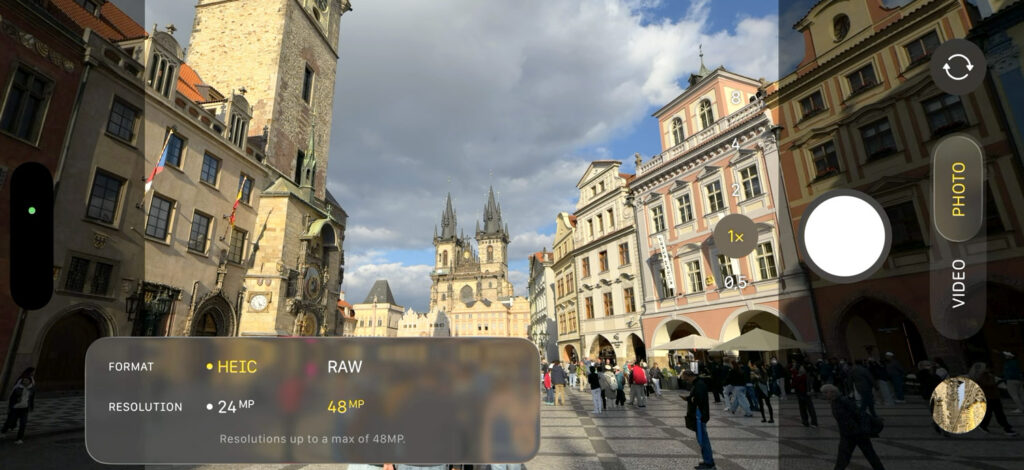
This is the second key question: what to think of the 8× zoom? The principle is simple — the 48 MP sensor covers 4× zoom. From that, a cropped portion equals an 8× zoom result.
Is it optical zoom in the strict photographic sense? Not exactly, since the lens isn’t projecting the full image on the sensor. But is it digital? Also no — the output is a 12 MP photo derived directly from the 48 MP data, so it’s more like a high-quality crop.
In practice, it depends on perception: in everyday use this zoom is perfectly usable, and Apple’s somewhat mysterious term “optical quality” actually makes sense.
One nuance: it’s not a simple crop. I tested and compared 4× and 8× results in detail — there’s no doubt Apple applies extra processing, refinements, and upscaling. The 8× photos generally look much better than a manual crop of a 48 MP source image.
By the way, Apple often mentions the term Fusion Camera but rarely explains it. In short: in some cases, signals and data from other sensors are merged (“fused”) into the final photo — mostly for the main camera, less so for the telephoto for obvious reasons.
3. Why photographers prefer 4× over 5× zoom
I admit I decided to switch to the iPhone 17 Pro the minute Apple announced its specs — because a shorter zoom is simply better for portraits and photographing people than the 5× zoom of the 16 Pro.
In short: photographers have always used so-called portrait lenses with focal lengths around 80–85 mm. The iPhone 15 Pro (3× = 77 mm) was close to that ideal; the iPhone 16 Pro (5× = 120 mm) made portrait shooting harder. The 17 Pro (4× = 100 mm) returns somewhat closer to the sweet spot. Hooray!
Conclusion: the iPhone 17 Pro pushes things further again
So what will I answer to the inevitable question — is it worth upgrading? Of course, this is just a partial look, since I’m comparing only telephoto lenses here. But that’s already an important piece of the puzzle (as usual, I’ll write a full review after several months of testing).
For regular and moderately demanding users: the difference compared to the 16 Pro will probably go unnoticed — so upgrading may not be necessary. But compared to the 15 Pro and older models, the improvement is quite significant.
For experienced photographers, the advantage of the “shorter” zoom counts — combined with better telephoto specs, upgrading makes sense even for 16 Pro owners.























Leave a Reply