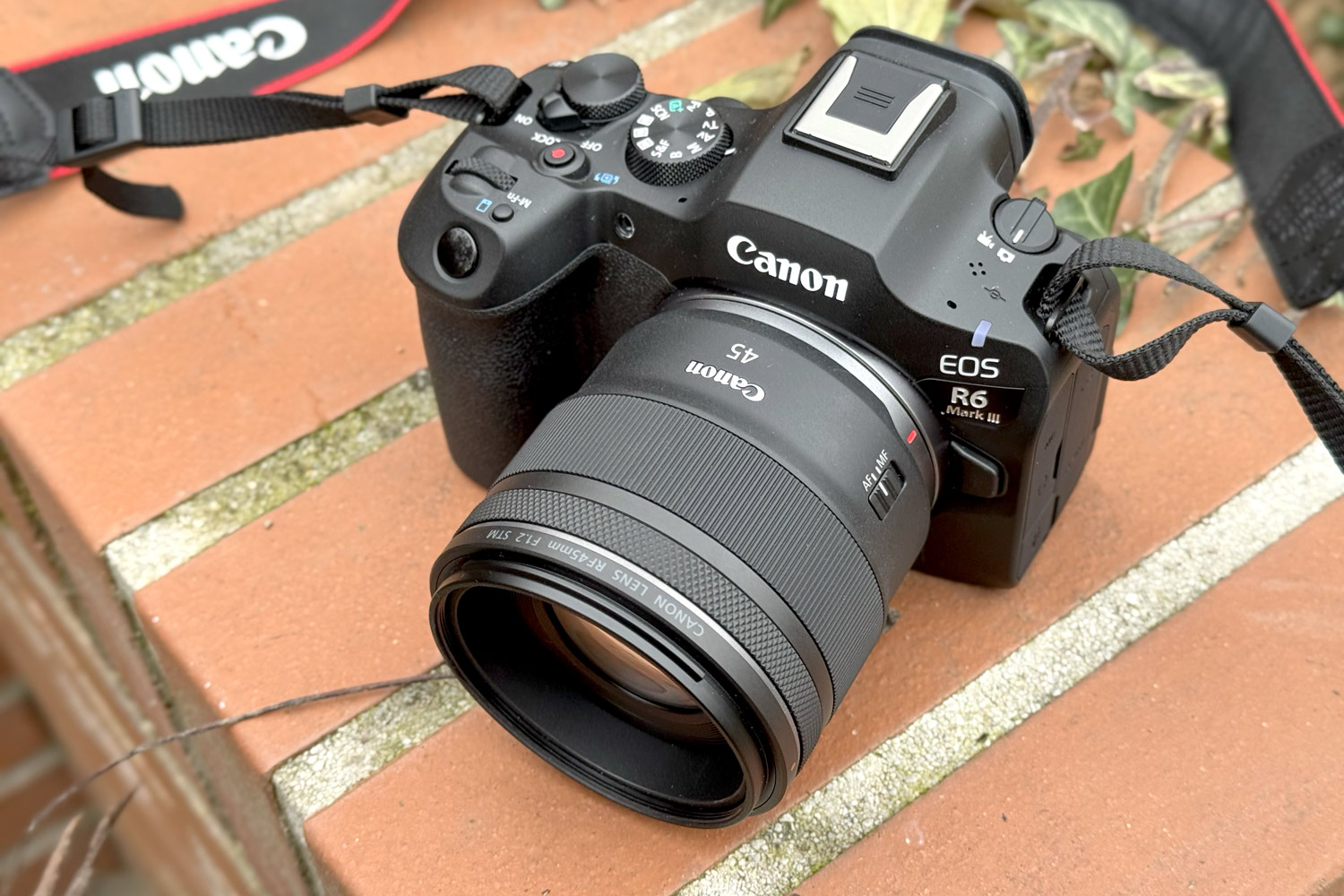
The Canon RF 45mm F1.2 STM is a compact lens with an extraordinary maximum aperture and an incredibly low price. What can you expect from it? What does it offer to both beginners and more experienced photographers? You can explore this in the review, the sample photo gallery, and my video on YouTube.
Extraordinary maximum aperture for $469
Yes, when something has great specs on paper, it usually can’t be cheap. And that’s why, I honestly admit, I didn’t actually expect much from this lens. Its official starting price is around $469, which is simply “suspiciously low” considering the f/1.2 maximum aperture.
So, I borrowed the lens and tested it for about a week on another new release of autumn 2025 – the Canon R6 Mark III body (review here). And I can write the truly crucial summary right here immediately – I was really pleasantly surprised: the performance is simply very good, and considering the price, I have no doubt this will be a highly popular lens.
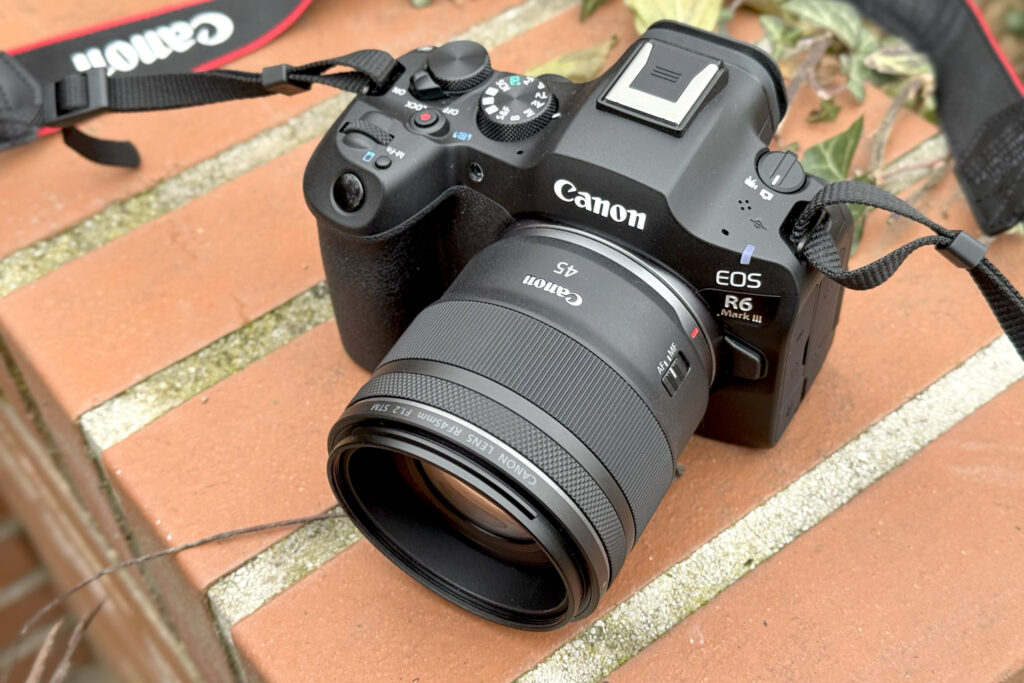
And where is the magic? The main attraction is obvious: the f/1.2 aperture simply offers truly maximalist “background blur”. Plus, of course, what applies to all prime lenses counts significantly here too: the image quality is simply good.


But in a way, the most valuable thing is that the extreme maximum aperture allows you to work creatively with “thin” depth of field. Not just for portraits, but also perhaps in landscapes or when shooting details: suddenly it is possible to “sneak” a sense of space into the photo even in situations where it usually isn’t very possible.
You can see all of this best in the gallery at the bottom of the page, and especially in the detailed video filmed and edited in 4K.
Video: What to expect from the Canon RF 45mm F1.2 STM – 14 min in 4K
Canon RF 45mm F1.2 STM – what I liked
Price/performance ratio is great – and results are unexpectedly good
The truly essential part of this review has already been mentioned in the previous paragraphs: this lens is better than you expect. And I am really not afraid to write it here directly – of course, those who look for optical flaws will find them (see below), but they don’t play a very significant role when shooting everyday life.
For a truly favorable price, owners gain a valuable addition to their lens collection that will help with portraits, but by far not only them.

It delivers truly maximal and elegant background blur
Yes, this sounds very banal and obvious, but it simply must be in the list of pros: at aperture f/1.2, the blur is truly extreme. It needs to be handled sensibly, but those who want to play around don’t need to worry.
As you will catch from the sample photos, portraits at this maximum aperture can be fascinating; the extraordinarily thin/shallow depth of field keeps only a thin layer of the photo sharp, which is impressive. The blurred background appears harmonious, which also counts.
To which, however, let’s quickly add the essential point: I would shoot portraits at f/1.2 only very exceptionally – yes, they look magical, but the depth of field is already so shallow that it places considerable demands on focusing accuracy and sharpness, but mainly: a maximally blurred background isn’t always maximally pretty.

Canon RF 45mm is great for creative experiments
This somewhat abstract feature seemed really crucial to me – yes, I like shooting with prime lenses, but f/1.8 on Canons or f/2 on Fujifilms is simply somewhere else than that remarkable f/1.2 aperture. What do I mean by that? That blur can be sneaked into places where it is usually “physically” impossible – see, for example, the photos of birds from the banks of the Vltava river.
As you can see from the sample photos, unlike lenses with less extreme maximum apertures, it is possible here to “separate” the background even with more distant objects (e.g., the bird is a few meters away, everything behind it is blurred, and in front of it too).
This is simply great for playing around – and it really dramatically shifts the possibilities of ordinary photography – as is known, maintaining a sense of space in a photo is one of the most important requirements for a good photo. And thanks to this lens, it can simply be conjured up in situations where we usually don’t have a chance.


Sharpness “wide open” isn’t bad
This actually surprised me a lot: as is known, every lens in the world produces softer images at the widest apertures compared to slightly narrower apertures. That’s just physics. I expected that, given the price, it would be on the edge of usability and that the nice photos would only start emerging around aperture f/1.6-1.8.
But no: as can be seen from the samples, the image is naturally softer, but it is still in a zone where it doesn’t threaten the quality.
Of course, it depends on the demands of the photographer and their goals, but for normal operation, no disasters will occur.


Sharpness at narrower apertures is very good
In the video, after the introductory section of photos at f/1.2, I have a passage about shooting at apertures that most photographers would automatically reach for, i.e., apertures from approx. f/1.8 to f/3, or even f/4. The demands on focusing don’t have to be so maximal, the background will still be beautifully blurred, but it will look more natural. And also, of course, the sharpness will be better.
And yes, in real life with the Canon RF 45mm F1.2 STM, I would probably stay at these values most often for portraits, because it makes the most sense, but mainly: the photos are simply beautiful.
The same will, of course, apply to landscape photography, although I didn’t test that much – November in Prague simply doesn’t favor landscape photography much. But I have no doubts, even here the image quality is simply what we expect from prime lenses.

The lens doesn’t feel cheap and is compact
One more admission: I expected the price to reflect in the overall build of the lens: that it would simply feel kind of cheap. But it didn’t happen: naturally, it’s not the build quality of the highest series, protection against dust and moisture is missing here, but when you pick the lens up, it simply feels solid. Don’t expect any cheap plastics here.
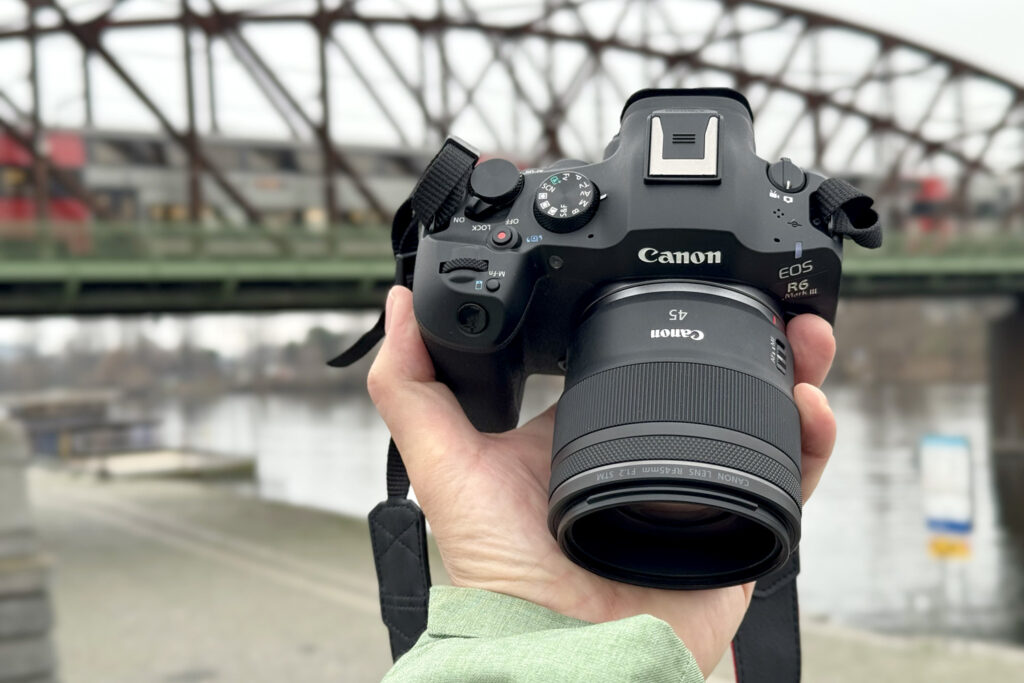
Plus, the dimensions are really not large – it is only 7.5 cm long and weighs a mere 346 grams. So: it is a likeable lens.
Focusing is quite snappy
And another property I automatically assumed due to the price doesn’t apply either – this is not a lazy lens. Which often happened and happens, that cheaper lenses are simply slow. Let’s not expect any dizzying focusing speed here, but on the other hand, there is really no need to fear laziness.
In the video, you will spot my tests on peacocks in the center of Prague – the servo managed to focus quite quickly without major problems even when I was approaching the peacock and shooting while doing so. Yes, it occasionally fell out of role, but then it quickly returned (the Canon R6 Mark III body naturally played a part in this too).
But overall, there is really no need to worry.

It will be big competition for the “Nifty Fifty”
For years, I have been forcing participants of my photography courses to buy a prime 50mm lens (the “nifty fifty”) as an affordable yet great piece of gear that will dramatically improve the photos of beginners and more advanced photographers alike. So, I briefly compared the Canon RF 45mm F1.2 STM with the Canon RF 50mm F1.8 STM, my favorite choice for various quick camera tests.
And of course, it remains true that it is a great lens, but the novelty will undoubtedly be considerable competition for it, even though it costs roughly twice as much. I quickly tested how both lenses perform “wide open” and it seemed to me that photos at f/1.2 are even slightly sharper on the new lens than the good old nifty fifty at f/1.8. Hats off…

Canon RF 45mm F1.2 STM – what to watch out for
It is a cheap lens – it doesn’t go without compromises
It really is a lens that offers quite a lot of bang for the buck. But it is, of course, necessary not to forget that it is simply a cheap lens that has its limits. Connoisseurs would likely easily reveal that lenses costing multiples more will perform better. Likewise, some might mind that it isn’t built for rough conditions and neither rain nor dust will do it good.
There is no stabilization here, which doesn’t bother me personally, because by definition it will be useful more for static things, but in some situations, it can be a limit. Likewise, the minimum focusing distance of 45 cm might be a bit of a limit for some users.
And in the overall sum, that statement simply holds true: it’s simply worth the money…

At the widest apertures, we find vignetting and softer image quality
Whoever looks for vignetting will naturally find it – and the edges of photos at lower f-numbers (wider apertures) will naturally be a bit darker. Which, truth be told, pretty much all lenses in the world do more or less. (See video for demonstration). You need to count on it, yes, but during normal shooting, it isn’t something that would have a significant impact on the quality of results.


The same applies to sharpness: if we compare corner sharpness at f/1.2 and (say) f/5.6, it will simply be softer at the higher maximum aperture (wide open). But it still holds true that in the overall sum, the quality at f/1.2 rather deserves praise.
Plus naturally, it applies: RAWs will help a lot: for photos where I spotted vignetting in JPG, opening the same photo in RAW really magically solved everything. The darker corners simply weren’t there. Which, I admit, is a bit strange: if Canon can instruct Photoshop to smooth everything out perfectly via profile corrections, it could surely do it in JPG too. But a bit of that vignetting remains there. But I repeat again: it is no drama.
Canon RF 45mm F1.2 STM – summary in two sentences
The Canon RF 45mm F1.2 STM offers very good performance for a reasonable price – and offers even more demanding users surprisingly good results in classic disciplines of prime lenses, including portrait photography. However, it also opens up interesting possibilities in other types of photography – because thanks to the extremely shallow depth of field, it allows working with space even where it is usually not possible.
Canon RF 45mm F1.2 STM – sample photos


Review Summary
Canon RF 45mm F1.2 STM

The Canon RF 45mm F1.2 STM offers very good performance for a reasonable price – and offers even more demanding users surprisingly good results in classic disciplines of prime lenses, including portrait photography. However, it also opens up interesting possibilities in other types of photography – because thanks to the extremely shallow depth of field, it allows working with space even where it is usually not possible.
7.8
Pros
- excellent price-to-performance ratio
- solid image quality at wide apertures
- compact dimensions and low weight
Cons
- no image stabilization
- vignetting at wide apertures






















Leave a Reply