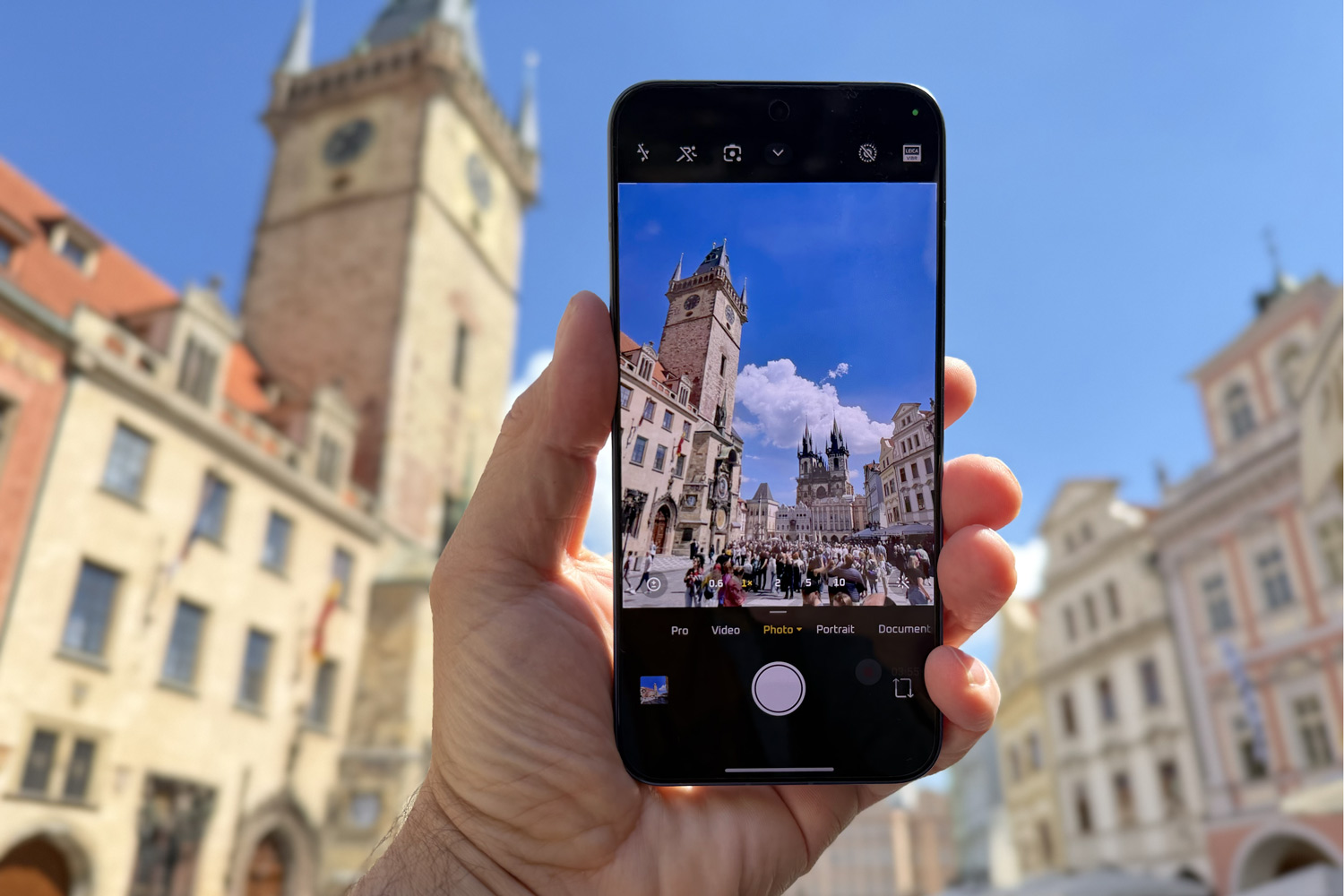
What to expect when photographing with the Xiaomi 17T Pro? Who is it for, and who is it not? And how does it differ from the previous generation? As always, I have tested this model in detail, written this review, and shot a video in which you can see more than 200 sample photos in HDR quality.
Where it belongs and who the Xiaomi 17T Pro is for
How to place this novelty on the imaginary mobile phone map? In recent years, the T-series from Xiaomi has always meant two models (the base and the Pro) and belonged to the popular choice within the affordable mid-range—in short, it always offered truly very solid performance for a reasonable price.
The previous generation pushed everything further—the Xiaomi 15T Pro (review here) belonged with its performance and equipment (5× optical zoom) rather to the upper mid-range and competed even with higher models á la Xiaomi 15. All this for a reasonable price.
In other words: I personally consider the Xiaomi 15T Pro to be an exceptionally successful mobile phone with an excellent price-performance ratio and one of the most reasonable choices for those who want truly solid performance and do not need or cannot afford the highest class.

And where does the Xiaomi 17T Pro fit into this now? Just to remind you, Xiaomi skipped the 16th series, so this is a direct successor—moreover, a successor that untypically appeared significantly earlier than the usual year: only eight months passed between the introduction of both models between September 2025 and May 2026.
The differences in photographic equipment are rather symbolic—a brief comparison of specs shows that the main sensor underwent an upgrade—there is the Light Fusion 950 here (the previous model had the Light Fusion 900).

I had the opportunity to try out the novelty in detail even before its official premiere, and it is obvious that it is once again a very good phone for versatile use. But it definitely still makes sense to get the Xiaomi 15T Pro as well—especially if it will be possible to buy it for a significantly better price.
Video: Xiaomi 17T Pro photography – 12 min in 4K HDR
Xiaomi 17T Pro and the camera
First, let’s take a look, as usual, at what system of sensors and lenses we have available.
| Xiaomi 17T Pro – Camera: Lenses and Sensors | |
|---|---|
| Main Camera | 23mm, 50 Mpx f/1.67, OIS Light Fusion 950 sensor (OV50Q) Sensor size: 1/1.31″ |
| Telephoto Lens | 115mm, 50 Mpx f/3.0, OIS Samsung JN5 sensor 5× optical zoom Sensor size: 1/2.75″ |
| Ultra-wide Camera | 15mm, 12 Mpx f/2.2, FOV 120° OV13B sensor Sensor size: 1/3.06″ |
| Front Camera | 21mm, 32 Mpx f/2.2, FOV 90° Sensor size: 1/3.42″ |
As in the past with previous generations, there is a combination of the main sensor, a telephoto lens (with 5× zoom), and an ultra-wide lens. The very presence of a telephoto lens is something that significantly distinguishes these models from other mid-range phones—personally, for example, I really like the series in which the latest model is the Samsung A57. But that one does not have a telephoto lens, which simply counts. It is also worth mentioning that there is a truly large battery with a capacity of 7000 mAh.

The key will, of course, be the main sensor with 23mm and 50 Mpx, while mentioning that in certain situations it makes sense to shoot even in full resolution, the details then truly stand out. In any case, it delivers very decent performance.
The presence of a 5× optical zoom is essential, this is still a novelty for this series: yes, the Xiaomi 15T Pro already had it too, but generations before that could not zoom in so generously (the Xiaomi 14T Pro model had only 60mm). In short, it is truly a significant element.

It is possible to zoom up to 120× magnification, how it works is best seen in the video, but such extreme values are, of course, already unusable. But the zoom is decently usable up to somewhere around 20-30x magnification. Which, of course, is also helped by the fact that it has 50 Mpx again.
And just to be sure, let’s add that there is, of course, no variable focal length zoom here, which is a big attraction on the flagship Xiaomi 17 Ultra (review here), which also has a so-called one-inch sensor.
Then there is, of course, the ultra-wide lens, which is sometimes a bit underestimated. It goes without saying that this is an addition that is only suitable for certain types of shots, but personally, I like using it very much. There is the only more significant compromise—it has only 12 Mpx, which is nevertheless sufficient in the vast majority of situations.

Lest we forget: the logo of the famous German company Leica, which participates not only in the optical systems but also in the software, is obviously unmissable. That means in image processing and filters, some of which bear its name. The exact same filters can be found in the famous cameras of this brand.
Xiaomi 17T Pro – what I liked
Generally a very well-tuned combination of parameters. The key thing about the Xiaomi 15T Pro could be summarized in one sentence: in the mid-price class, it offers a truly unprecedentedly good combination of performance, photo quality, and the spectrum of what can be captured: from Leica filters to high-quality lenses. And it is obvious that the same can be said about the Xiaomi 17T Pro.

Very good imaging performance—so yes, another simple and essential sentence: this phone simply takes good photos. We cannot, of course, expect the maximalist performance of flagships, but ordinary users will be satisfied with the photos, as will more demanding, experienced photographers. Generally speaking: from the standpoint of everyday shooting, there isn’t much to criticize about this phone.

The main sensor does a good job—the main sensor and lens are, of course, the vital element that decides a significant part of the shooting impression. As can be seen from the sample photos here on the page and in the accompanying video, I tested again in many places and in many different situations. And the results are very good.

The 5× optical zoom is a truly highly valuable feature—as I already mentioned, this high-quality telephoto lens became one of the most prominent parts of the equipment in the Xiaomi 15T Pro. Also what defines these models on the imaginary map of camera phones. In short: it deserves praise not only as a major attraction among mid-range phones, but above all as an element offering solid performance.

Solid portrait mode—portrait mode is sometimes a bit neglected in reviews, yet it is one of the essential tools that comes in handy not only for portraits of people, but also for shooting various objects. This time, Xiaomi made it clear that there has been a shift for the better in “background blurring” and that the work of algorithms in complicated areas, such as messy hair, should be more precise.

Digital zoom does a decent job—digital zoom is, of course, a term that sometimes sounds terrifying to more experienced photographers. Naturally, quality goes down and maximum values á la 120× are more of a technical curiosity. But within reasonable limits, there is no need to fear digital zooming; up to somewhere around 20-30×, the results are still very solid.

Really nice macro photos—macro generally doesn’t work well on mobile phones for a variety of technical reasons. And macro photos are mostly unusable. Here too, it is necessary to be vigilant and expect that it is impossible to come close to the performance of a camera. But as can be seen, for example, from the photo of that scary-looking fly, with a bit of luck and practice, it can turn out very decently.

Solid Leica filters—I admit, I hardly use filters at all (= not at all), but the more I test them, the more I acknowledge that they have a certain charm. Which applies doubly here, because few can do “color science” as excellently as Leica. In short, I recognize that it can have a great charm for a part of the user base.

There is high-quality video here—I usually try to avoid evaluating video because, unlike photos, I simply don’t understand it as much. With many phones, however, it held true for a long time that video quality lagged slightly behind photographs. This was noticeable, for example, from comparisons with iPhones, which were always a few steps ahead in video. Here, however, the video definitely does not make a weaker impression.

Xiaomi 17T Pro – what to watch out for
A few details still need to be fine-tuned—as almost always, a few things can be found that are still worth wrapping up—for example, with the Leica Vibrant style, I sometimes felt that the colors were a bit too saturated. However, I tested the model even before its premiere, so such minor details can be dismissed with a wave of the hand. In the vast majority of cases, a future update will fine-tune everything within a few weeks.
It’s not exactly a small phone—this is actually the only more significant complaint I have: it is a relatively large phone, noticeably larger than, for example, iPhones. Which might discourage a few users. Xiaomi, however, made everything in this generation so that the base Xiaomi 17T model has very similar parameters (including optical zoom) but smaller dimensions. In any case, I will test this model soon too, but it’s good to keep it in mind.

The previous generation truly competes with it—I have stated this several times already, but that’s just how it is: the Xiaomi 17T Pro doesn’t bring any dramatic changes compared to the Xiaomi 15T Pro. If the price difference is noticeable, it will definitely make sense to buy the older generation too.
Xiaomi 17T Pro – summary in two sentences
The Xiaomi 17T Pro offers a very good combination of specifications, including a 5× optical zoom and software features, still within the mid-range. The shift from the previous generation is not dramatic, but it is undeniably a remarkable model for wide use in casual photography, as well as for use by more experienced photographers.
Xiaomi 17T Pro – more photos from the test


Review Summary
Xiaomi 17T Pro
The Xiaomi 17T Pro offers a very good combination of specifications, including a 5× optical zoom and strong software features, while still remaining in the mid-range category. The improvement over the previous generation is not dramatic, but it is undeniably a noteworthy model for a wide range of uses — both for casual photography and for more experienced photographers.
7.9
Pros
- Very good image quality
- Above-average specs for the mid-range category
- Valuable 5× optical zoom
Cons
- Larger dimensions
- Competition from the previous generation
- A few minor details still need fine-tuning
Related posts
-

Xiaomi Redmi Note 15 Series Specs Comparison: All 5 Models
-
Best Smartphones for Photographers (2026) – My Top Picks Based on 10 Years of Reviews
-
Xiaomi Redmi Note 14 camera test: review + 200 sample photos
-

Xiaomi 15T camera review: 150 test photos + video in HDR
-

Xiaomi 15T Pro camera review: 200 test photos + video in HDR






















Leave a Reply