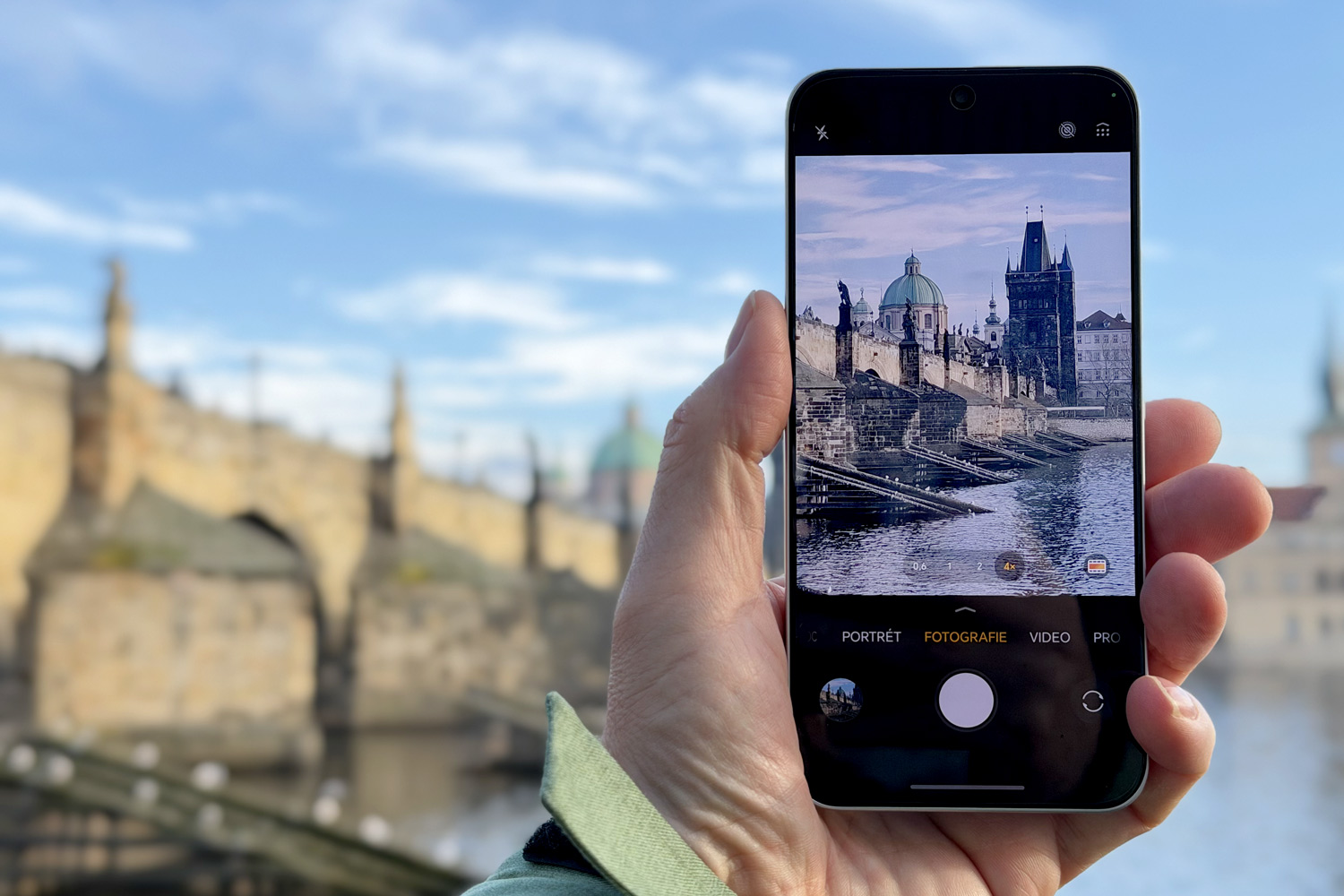
The Honor 400 belongs to the affordable mid-range mobile phones, attracting customers with a 200 MP sensor. But what can you expect from its photography performance? What does it offer users in various situations? I tested all of this in detail in December Prague. And here is my detailed review, including a gallery with roughly 50 sample photos. You can also watch a video in HDR quality, where you will see even more photography.
Honor 400: Mid-range with 200 MP
In the past, I have only tested flagships from Honor, such as the Honor Magic7 Pro, which I consider a very good model that is not as popular as it deserves to be. Or the Honor Magic V5 (read the review here), which is a special type of device, half phone, half tablet.
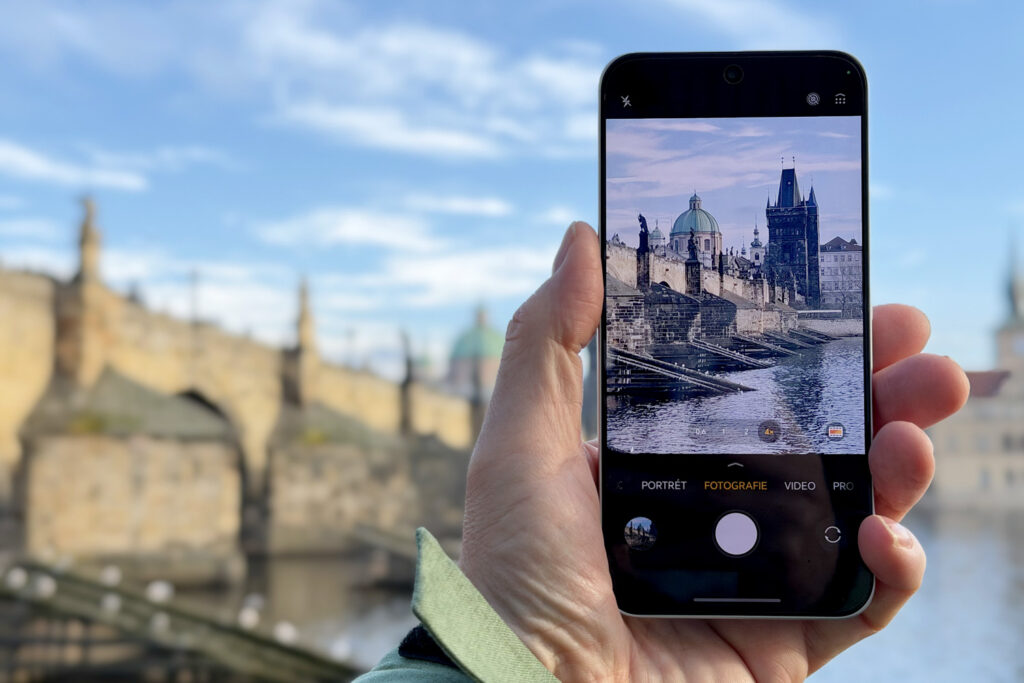
But similarly to Xiaomi or Samsung, I was interested in how phones from the other end of the spectrum are doing, so I decided to test the Honor 400. Strictly speaking, it is not the “other end of the spectrum” because it is not a budget phone, but a decently equipped representative of the mid-range. This is a very important category of mobile phones – I personally am very fond of it because it gives tens of millions of people around the world the chance to take great photos. And it is exactly here that the most interesting revolutions in photography are happening: because it is in the mid-range that the shift towards better quality (at a still acceptable price) is felt the most.

I considered testing the Honor 400 Pro, which offers an extra 3x zoom, but my choice finally fell on the “more ordinary” Honor 400, a popular choice for those interested in a good price-performance ratio. The test took place during the pre-Christmas period in Prague (Czech Republic), when it is great to photograph the night city full of lights as well as fog over the Vltava River.

Video: How the Honor 400 photography – 12 min in 4K
Honor 400 – camera specs
Let’s first look at the camera equipment; you can see everything best in the following table.
| Honor 400 – Camera: Lenses and Sensors | |
|---|---|
| Main Camera | 27mm, 200 MP, f/1.9, OIS Sensor size: 1/1.4″ |
| Ultra-wide Camera | 16mm, 12 MP, f/2.2 |
| Front Camera | 50 MP, f/2.0 |
| Processor | Snapdragon 7 Gen 3 |
The key role will, of course, be played by the main lens and sensor. The 200 MP sensor is one of the biggest attractions of this model. Personally, I am a bit skeptical of “megapixel races,” where manufacturers unofficially promote the slogan “the more pixels, the better the phone.” But here it really makes sense, because thanks to it, the Honor 400 is capable of zooming quite decently.
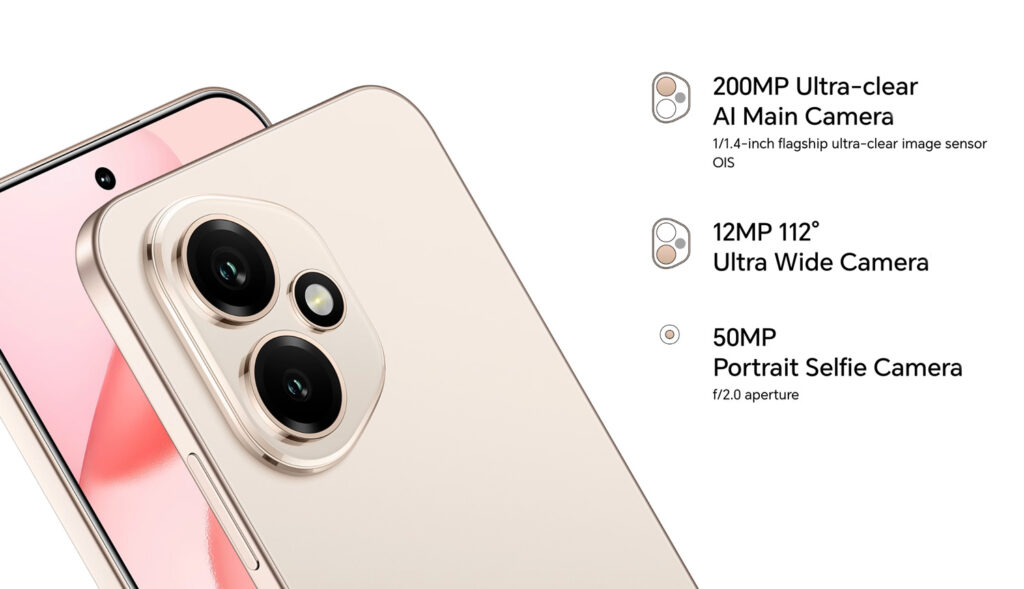
There is no telephoto lens here – as implies from the specs, unlike (for example) the Honor 400 Pro, the telephoto lens is missing here. And all zooming therefore happens from the main sensor, sometimes with substantial help from artificial intelligence algorithms.

The second lens/sensor is the ultra-wide camera – it has 12 MP, which counts: sometimes manufacturers are tempted to save money on this parameter and 8 MP would simply be too little. Here it works very decently.

It is also important to mention the processor, i.e., the Snapdragon 7 Gen 3, which helps fundamentally in processing photographs.
Naturally, as always, a number of additional modes are available, including Super Macro, Night mode, and perhaps the option to shoot in full 200 MP resolution. We will analyze this in more detail below – and you can see it best in the video where I test these options live.

When shooting, we can choose from three styles: Vibrant, Natural, and Authentic, whereas the Authentic one isn’t actually very authentic: it adds vignetting (darker corners) to the photo and highlights colors relatively fundamentally.
Honor 400 – what I liked
The 200 MP sensor does a very decent job – this is actually the most important thing of all: as you can best see from the gallery on this page (and mainly from the video), the bet on the 200 MP sensor really pays off here. I tested the Honor 400 in many different situations and generally, it can be said that there is definitely no need to worry about the results. A less demanding user will definitely not be disappointed, and in many respects, even more experienced and demanding users will be satisfied. In short: considering the price, this phone simply takes good photos.

The ultra-wide lens is not just a marginal feature. Sometimes it happens that the ultra-wide sensor is significantly weaker than the main one. People often don’t notice it because – after all – they don’t shoot with it that often. And manufacturers like to rely on that. However, that did not happen here – it is not an insignificant accessory, but a full-fledged part of the camera.

200 MP successfully helps digital zoom. As I mentioned, the telephoto lens is missing here and all zooming is “in charge” of the main sensor and lens. The zoom is therefore purely digital and allows us to go up to 30× magnification. Of course, that is already quite extreme and not very usable in practice. But the essential thing is that at reasonable zoom values, the results are actually better than I expected. Yes, we probably won’t make large prints from it, but for quick photos for social networks, why not.


Photo processing is helped by AI – just at the maximum magnification of the digital zoom, it is possible to see nicely how artificial intelligence engages in the result. If you quickly open the photo after taking it, you will see it in its original state, but within a second or two, everything sharpens, fills in, and recalculates. Here too, it applies that at smaller zoom values, it turns out surprisingly decently.
Very good results in night photography – I tested this phone in the middle of December and saw the sun for only a few hours. Instead, I enjoyed photographing in the evening and at night. And it turned out very well, as you can again see best in the video, but also here in the gallery. The Honor 400 has a specialized Night mode, which takes a few seconds of recording and then creates the resulting photo from it. Sometimes it really helps in quality, but it is important to mention that even the “normal” camera delivers very decent performance – and the vast majority of my night photos in this review were created during normal shooting, not when using the Night mode.

An interesting option is shooting in full resolution – in some situations, it is interesting to try to “extract” a photo in full 200 MP resolution from the phone. The image has truly unprecedented dimensions: 16,384 px by 12,288 px. It naturally doesn’t make sense for normal shooting, but in certain situations, it is interesting to play with it: especially when we need to capture extraordinarily fine details.
Honor 400 – what to watch out for
The telephoto lens is missing here – I have already mentioned this several times: a “zooming” lens is missing here and we, therefore, have to zoom digitally from the main sensor. It is not a bug, it is simply a feature of this phone. At lower values, it turns out well, but it will always be a certain limit.

It is a mid-range camera – one needs to keep this in mind. Mid-range phones sometimes have it tough – owners expect them to be more or less comparable to the best that exists during normal shooting. But that’s simply not the case. Very decent performance, yes. But the higher classes are simply further ahead.

Artificial intelligence sometimes makes things up a bit. As I mentioned above, algorithms get involved quite actively in photo editing. It is best seen when “sharpening” zoomed photos. Occasionally, however, it is no longer about sharpening, but about inventing details. Again, it applies: it is not a bug in principle, but a feature of a mid-range phone. But you need to count on it.
Styles would deserve a bit of tweaking – styles allow owners to choose what the color rendering and intensity will be. The Authentic style is already relatively prominent, but the differences between Vibrant and Natural are not significant, which could definitely be worked on.

Video doesn’t support HDR. This is a small thing, but it would also be worth refining: when shooting video, it is not possible to record in HDR (unlike photography). For the vast majority of users, this is undoubtedly irrelevant, but personally, I think it should simply be a standard. In a few years, HDR displays will be everywhere and commemorative recordings will then simply be a bit boring, without glowing highlights in the sky and radiant colors.
Honor 400 – Quick summary
The Honor 400 offers users a very good price-performance ratio and mid-range performance. The main attraction is the 200 MP sensor, which holds up well in a number of situations and offers a wide range of additional functions. The phone is a good choice for those who want good photos but do not need, or cannot afford, higher-end models.
Honor 400 – more sample photos from the test


Honor 400

The Honor 400 offers users a very good price-performance ratio and mid-range performance. The main attraction is the 200 MP sensor, which holds up well in a number of situations and offers a wide range of additional functions. The phone is a good choice for those who want good photos but do not need, or cannot afford, higher-end models.
7.6
Pros
- Good performance of the 200 MP sensor
- Wide spectrum of additional functions
- Overall good photos
Cons
- There is no telephoto lens here
- Image processing reflects its mid-range status
- Video does not offer HDR recording
Related posts
-

Honor 600 Pro Camera Review: 50 Sample Photos + Video
-
Honor Robot Phone: Camera, Gimbal and… Robot — First Look in Barcelona
-
Honor Magic8 Pro Camera Review: 50 Sample Photos + Video
-
Best Smartphones for Photographers (2026) – My Top Picks Based on 10 Years of Reviews
-
Honor Magic V5 Review: 200 Sample Photos & Video
























Leave a Reply